we’re awkward in photos: how to make your engagement session feel natural
nearly every couple tells me they are awkward before their engagement session.
not some couples.
nearly all of them.
sometimes they mention it casually in an email. sometimes they announce it the second they get out of the car, before i have even said hello. occasionally one person points directly at the other and says, “he hates pictures,” like i have been asked to photograph a mildly uncooperative hostage.
then we start.
within a few minutes, they are walking together, laughing, leaning into each other, and forgetting to monitor every inch of their bodies.
they were never actually bad at photos. they just assumed they were supposed to arrive already knowing what to do.
you are not.
that is my job.
you are not expected to know how to pose
most people have no reason to know how to pose for engagement photos.
you have probably spent years taking quick phone pictures, group photos at family events, and selfies where you can see yourself while adjusting the angle. none of that prepares you to stand in front of another person’s camera while trying to look relaxed on command.
that does not make you awkward. it makes you normal.
professional models practice posing. they learn how small movements change the way clothing falls, where light hits, and how their body appears from different angles.
you are not expected to study any of that before your engagement session.
you do not need to arrive with a rehearsed smile, a list of poses, or a private performance prepared for me. you only need to show up willing to interact with the person you already know how to be around.
i will handle the rest.
natural photos are not usually completely unposed
there is a strange assumption that natural-looking photographs happen because the photographer says nothing and waits for something beautiful to occur.
sometimes that works.
sometimes it results in two people standing silently beside each other, wondering whether they should kiss or pretend to inspect a nearby tree.
natural-looking engagement photos still require direction.
the difference is that the direction should create interaction instead of forcing you into a position that does not make sense for your relationship.
i may ask you to walk together, pull each other closer, whisper something, look at each other, lean in, or hold hands in a specific way. i may adjust where your feet are, move one hand, or slightly change the angle of your bodies.
that is posing.
it just should not look like posing.
the goal is to give you enough direction that you feel secure without controlling every breath and expression.
you do not need to perform your relationship
your engagement session is not an audition for the role of most romantic couple in central illinois.
you do not need to spend the entire session dramatically kissing in a field.
some couples are naturally very affectionate. others are playful. some are quieter. some communicate almost entirely through sarcasm and bothering each other.
all of that is useful.
the session should reflect how the two of you actually interact.
if you are constantly laughing together, we will use that. if you are more reserved, the quieter photographs may become the strongest part of the gallery. if one of you cannot resist making the other laugh at inappropriate times, i am probably going to encourage it.
you are allowed to be yourselves instead of trying to imitate the relationship you think engagement photos are supposed to show.
tell me when something is not you
i can guide you better when i know what feels unnatural.
maybe you hate having your forehead touched.
maybe your fiancé would rather walk into traffic than attempt a dramatic dip.
maybe you are comfortable kissing but not while standing in the middle of a crowded downtown sidewalk.
maybe one of you cannot whisper anything remotely romantic without laughing.
that information helps me.
you will never offend me by saying, “this does not feel like us.”
i would rather change the direction than spend ten minutes trying to force a photograph that does not belong in your gallery.
good guidance is not about making every couple do the same poses. it is about noticing what works and adjusting quickly when something does not.
movement helps more than standing still
standing still gives your brain too much time to become involved.
suddenly you are thinking about your hands, chin, posture, smile, hair, stomach, feet, and whether you have always blinked this much.
movement interrupts that.
walking together is one of the easiest ways to begin because it gives your body something familiar to do. you can hold hands, look at each other, bump shoulders, pull each other closer, or talk while you move.
even very small movement helps.
you may shift your weight, run a hand down your partner’s arm, adjust their collar, move in for a kiss, or lean against them.
the final image can still look calm and intimate. the movement simply helped you reach that position without feeling like you were placed there and ordered not to move.
your hands are not your responsibility
people become deeply concerned about their hands during photos.
this concern usually appears after someone has seen one awkward photograph where their arms were hanging straight down and decides their hands can never be trusted again.
i will tell you where to put them.
you may hold hands, touch your partner’s arm, wrap an arm around them, place a hand on their chest, touch their face, adjust their clothing, or rest against them.
the important thing is that your hands look connected to what is happening.
random hands are awkward.
intentional touch usually is not.
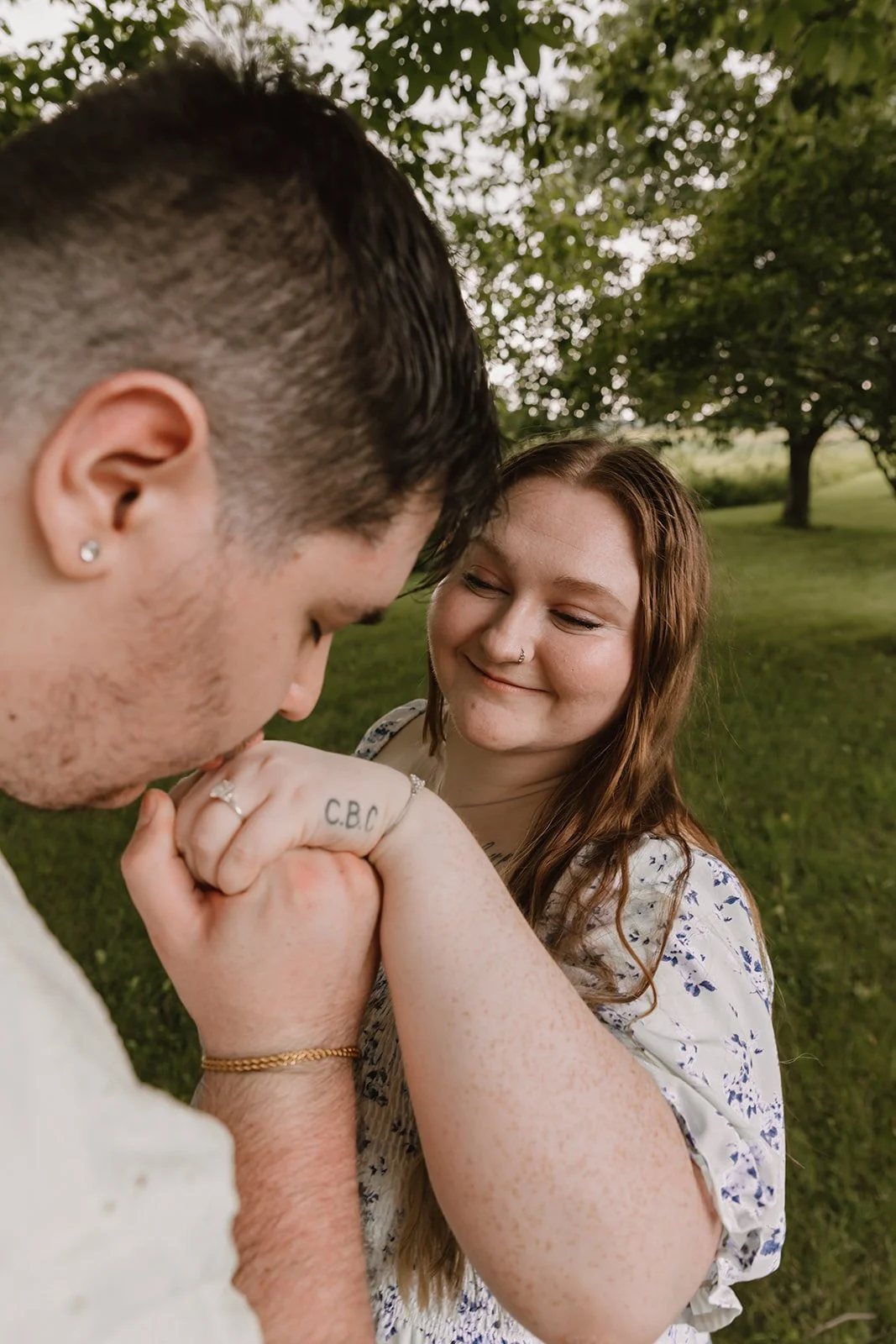
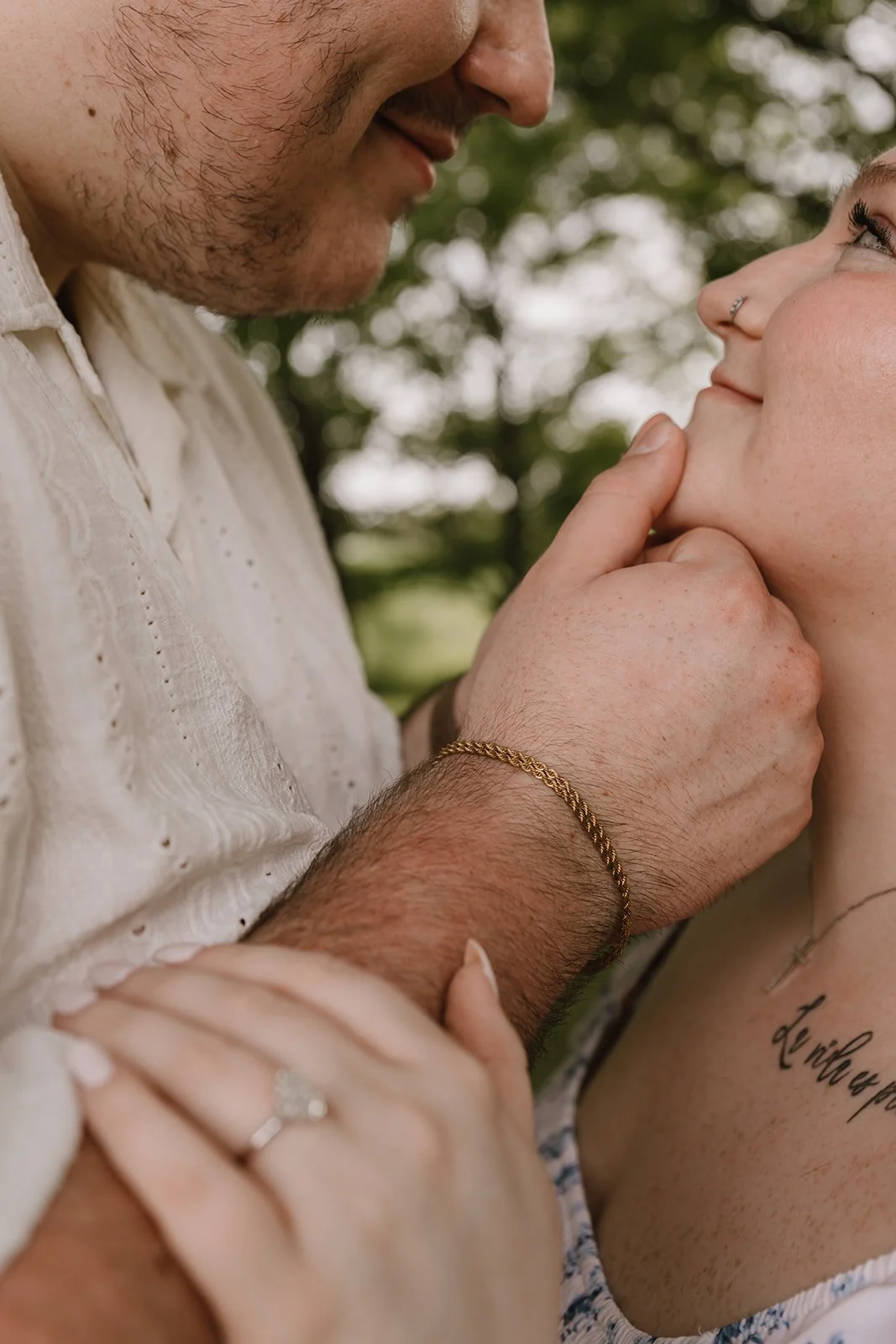
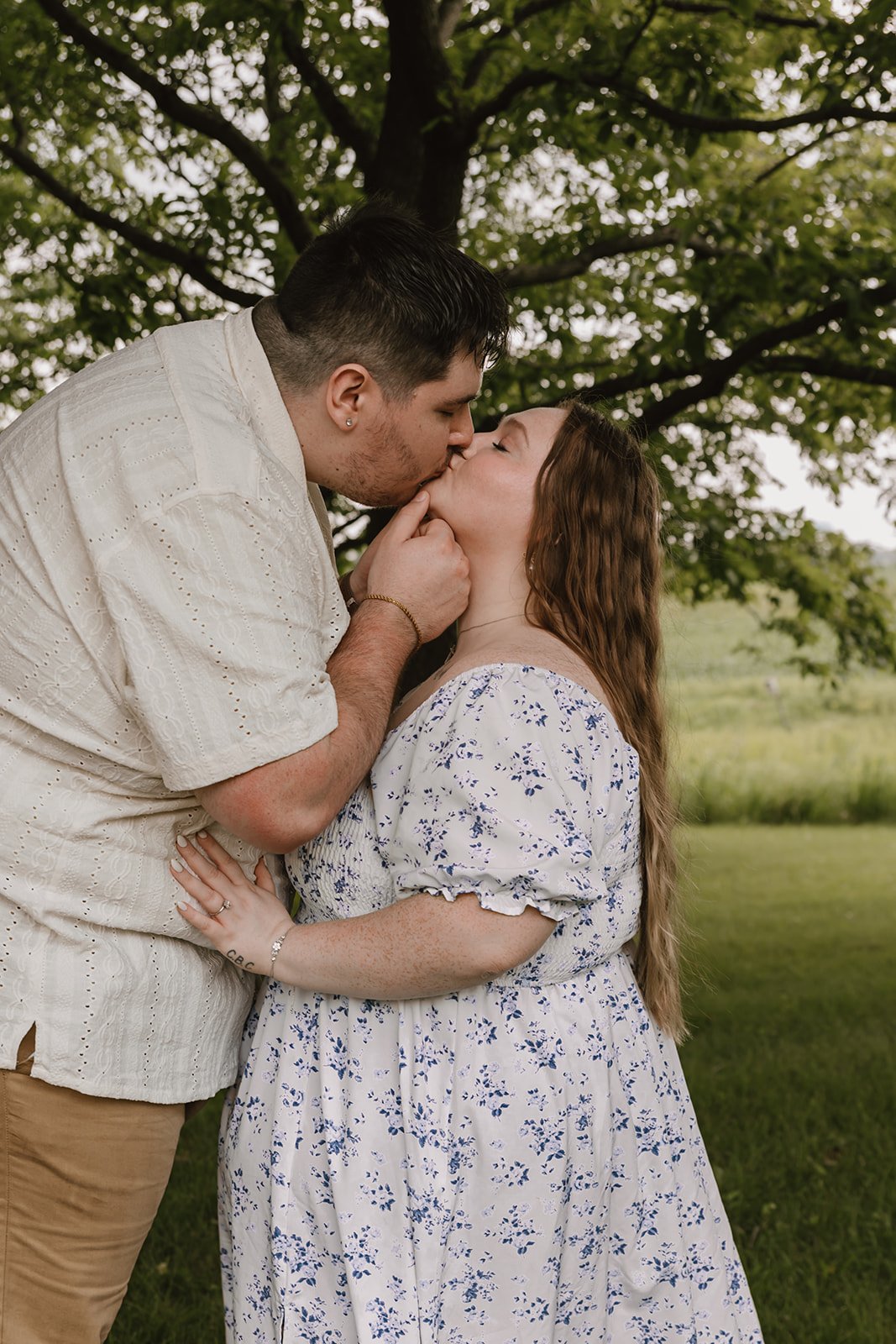
the close-up photographs from this session work because their hands are part of the interaction. his hand beneath her chin, her hands around his arm, and the kiss on her hand all tell us something about how they are relating to each other.
none of those details require you to arrive with advanced hand-placement knowledge.
one person usually warms up faster
it is very common for one person to be more comfortable in front of the camera.
sometimes that person loves having photos taken. sometimes they simply recover from the initial awkwardness faster.
the other person may take a little more time.
that is okay.
i am not expecting both of you to arrive at the exact same comfort level. i am also not going to make the more nervous person spend the first ten minutes alone in front of the camera while everyone watches.
we start together.
being close to your partner gives you something familiar to focus on. instead of thinking only about the camera, you can look at them, talk to them, or react to what they are doing.
usually the person who “hates photos” becomes much more comfortable once they realize the session is not going to be an hour of forced smiling.
stop worrying about whether you are photogenic
“photogenic” is often treated like a personality trait people are born with.
some people supposedly have it. everyone else must apologize before the camera comes out.
in reality, looking good in photographs depends on a lot of things:
lighting
angles
lens choice
body positioning
expression
timing
comfort
connection
the photographer’s ability to notice what is working
you have probably seen a bad photograph of someone you know is attractive. you have also probably seen someone look incredible in one photo and uncomfortable in the next.
that is because photographs are not neutral evidence of how a person looks.
they capture one angle, one fraction of a second, and one specific combination of light and expression.
a poor photograph does not prove you are bad at photos.
it proves that particular photograph did not work.
my responsibility is to pay attention to the details that make a photograph flattering and meaningful. your responsibility is not to constantly inspect yourself from the inside while i work.
you do not have to look at the camera constantly
some of the strongest engagement photographs happen when neither person is looking at me.
looking at the camera has its place. your parents and grandparents will probably appreciate at least one photograph where they can clearly see both of your faces.
but an entire gallery of camera-facing smiles would not show much about your relationship.
looking at each other creates connection. looking down can create softness. closing your eyes during a kiss can make the photograph feel more intimate. glancing away while laughing may capture an expression that disappears the second you are told to smile.
you do not need to maintain eye contact with the camera like it is interviewing you for a job.
i will tell you when i need you to look at me.
the rest of the time, you can focus on each other.
laughing is not the only sign that you are comfortable
photographers talk a lot about laughter.
laughter is wonderful. it creates movement and expression, and it often helps people loosen up.
but not every photograph needs to involve throwing your head back.
quiet moments matter too.
the way you rest against each other, the expression you make when your partner is not looking, the way your hands naturally meet, and the pause before a kiss can say just as much as a huge laugh.
this gallery includes both.
there are smiling photographs, but there are also close, calm images where the connection comes from touch and expression instead of an obvious reaction.
natural does not always mean energetic.
sometimes it means still enough to notice each other.
choose a location where you can settle in
location affects more than the background.
it affects how comfortable you feel.
some couples love the movement and energy of downtown peoria. buildings, sidewalks, brick, and city streets give them something to interact with.
others feel more relaxed somewhere quieter, such as a park, open field, wooded area, garden, or meaningful private property.
neither option is more natural than the other.
the best location is one that fits the appearance you want while allowing you to interact without feeling distracted the entire time.
central illinois gives us plenty of variety. we can use green spaces throughout peoria, pekin, east peoria, morton, washington, dunlap, metamora, and surrounding areas, or choose an urban setting with more structure and movement.
you do not need to locate a secret field no photographer has ever seen.
a familiar location can still look personal when the focus is on the two people inside it.
wear something you can stop thinking about
your outfit does not need to be perfect, but it should allow you to move and focus on the session.
clothing that is too tight, constantly slips, shows more than you intended, or requires adjustment after every movement will make it harder to relax.
choose something that fits you now and allows you to walk, sit, lean, and move comfortably.
that does not mean you have to dress casually.
you can wear a beautiful dress, a structured outfit, heels, or something more formal. just test it before the session.
sit down.
walk around.
hug your fiancé.
raise your arms.
make sure you can breathe.
you should not discover fifteen minutes into the session that the outfit works only when you stand perfectly upright and do not move your shoulders.
when your clothing is comfortable, you can forget about it.
that is the goal.
do not practice facial expressions in the mirror
you do not need to train yourself to produce a perfect natural smile.
the more you monitor your face, the less natural it usually becomes.
instead of asking you to smile repeatedly, i will create situations where an expression can happen.
i may ask your partner to make you laugh, tell you to look at each other, give you something to do, or say something mildly ridiculous from behind the camera.
sometimes the best expression happens immediately after the obvious one.
you laugh, then look back at your partner.
you kiss, then both smile.
you try something awkward, then react to how awkward it was.
those small transitions are often better than the original direction.
that is why i keep photographing instead of taking one image and immediately lowering the camera.
trust the first few minutes
the beginning may feel strange.
that does not mean the whole session will feel strange.
you are entering a new environment, working with a camera pointed at you, and trying to understand what i mean when i tell you to move closer even though you already believe there is no remaining space between your bodies.
give yourself a few minutes.
you do not need to be instantly comfortable to have a good session.
comfort usually builds as you learn how i direct, realize you are not expected to perform, and see that i will not leave you standing silently without instructions.
the beginning is not a test.
it is simply the part where we figure each other out.
your engagement session is useful before the wedding
engagement photos are not only for save-the-dates or social media.
the session also gives you experience working with your wedding photographer before the wedding day.
you learn how i communicate.
you see how small adjustments work.
you realize that you do not have to create every expression yourself.
i learn how the two of you interact, who becomes comfortable first, what makes you laugh, and which kinds of direction suit you best.
that matters when the wedding day arrives.
your schedule will be fuller. more people will be around. emotions will be higher. you may have limited time for portraits.
already knowing how we work together makes the process easier.
you are not starting from zero while wearing formal clothing and surrounded by your entire wedding party.
the goal is not to eliminate every awkward second
something awkward may happen.
you may misunderstand a direction.
you may attempt a pose and immediately start laughing.
you may step on each other.
someone may make a face.
that is not a failure.
sometimes those moments become part of the gallery. sometimes we laugh and move on. sometimes i adjust what i asked you to do.
the goal is not to behave perfectly for an hour.
the goal is to create enough comfort that the awkward moments do not control the session.
you are allowed to be a real couple instead of two professionally trained humans who have never bumped foreheads during a kiss.
what i need from you
i do not need you to know how to pose.
i do not need you to lose weight, practice smiling, or become more comfortable with cameras before we meet.
i do not need your fiancé to suddenly develop a passion for professional photography.
i need you to show up, stay open to direction, and focus on each other more than the camera.
tell me when something feels wrong.
laugh when something is funny.
take a breath when you need one.
trust that i am paying attention to the angles, light, hands, expressions, and all the other things you are worried about.
you do not have to manage the session from inside the photographs.
you are probably less awkward than you think
most couples who call themselves awkward are not awkward together.
they are awkward when they become aware that someone is watching.
there is a difference.
once you stop trying to create photographs and start responding to each other, the entire session changes.
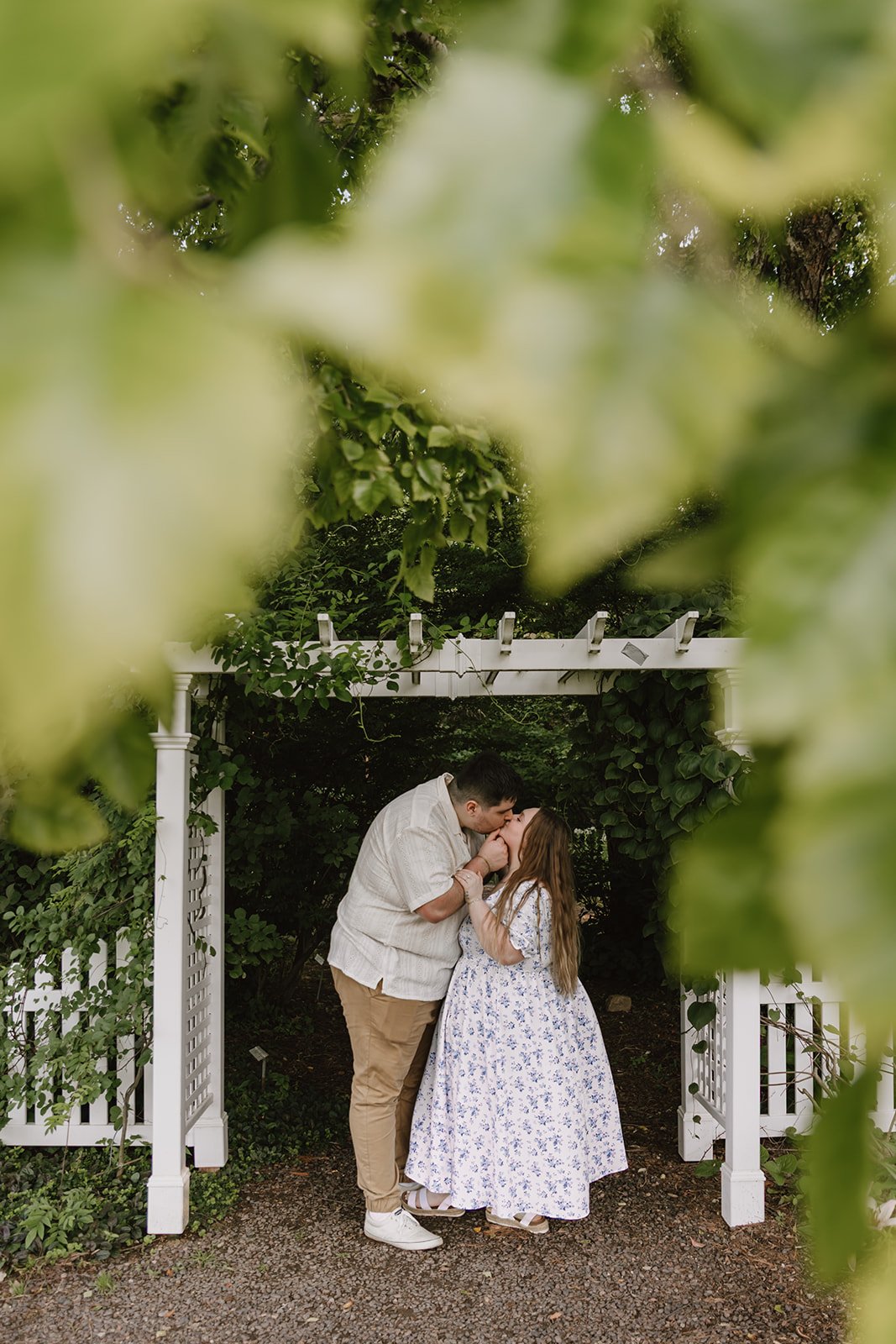
the hand kiss looks natural because it is connected to her.
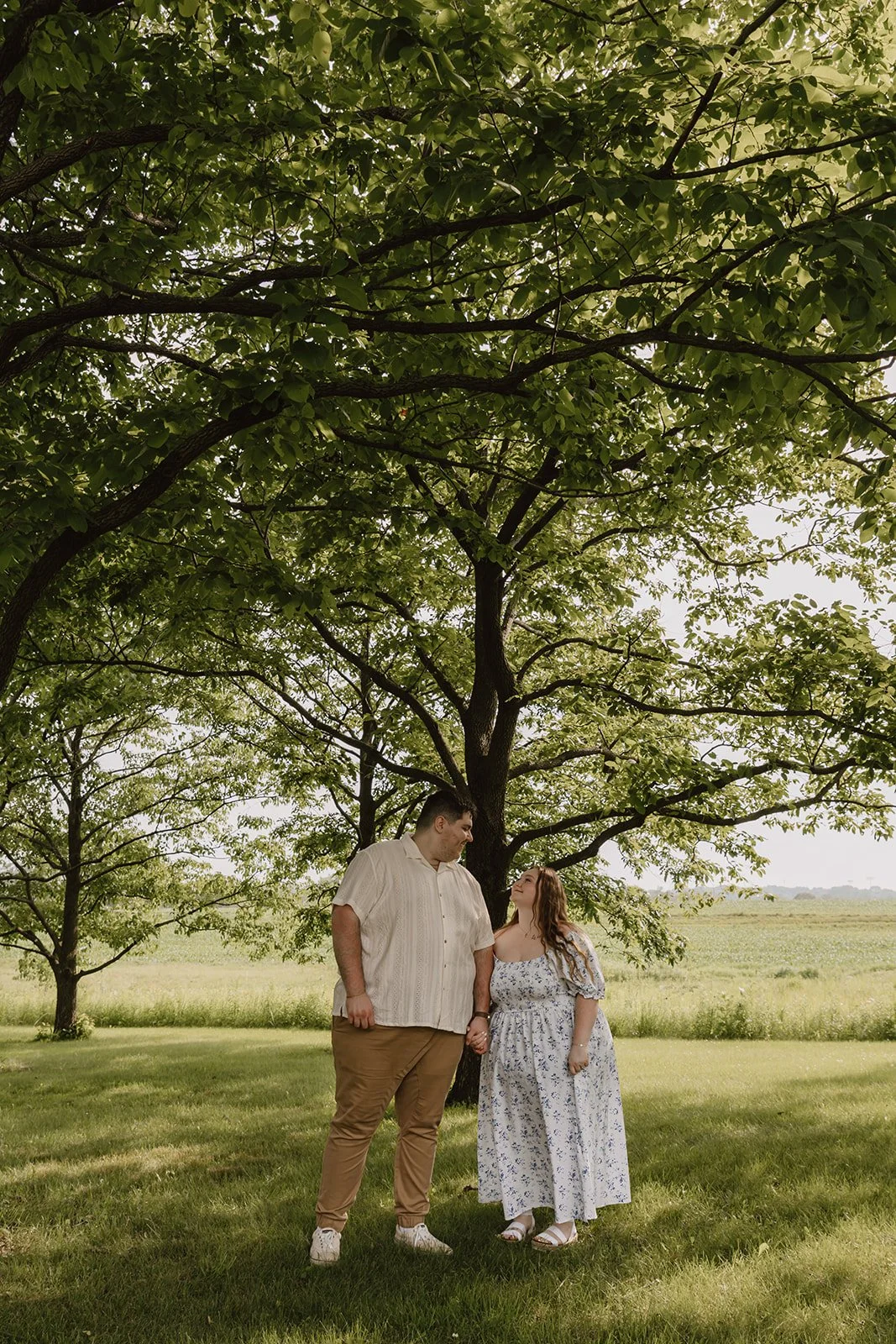
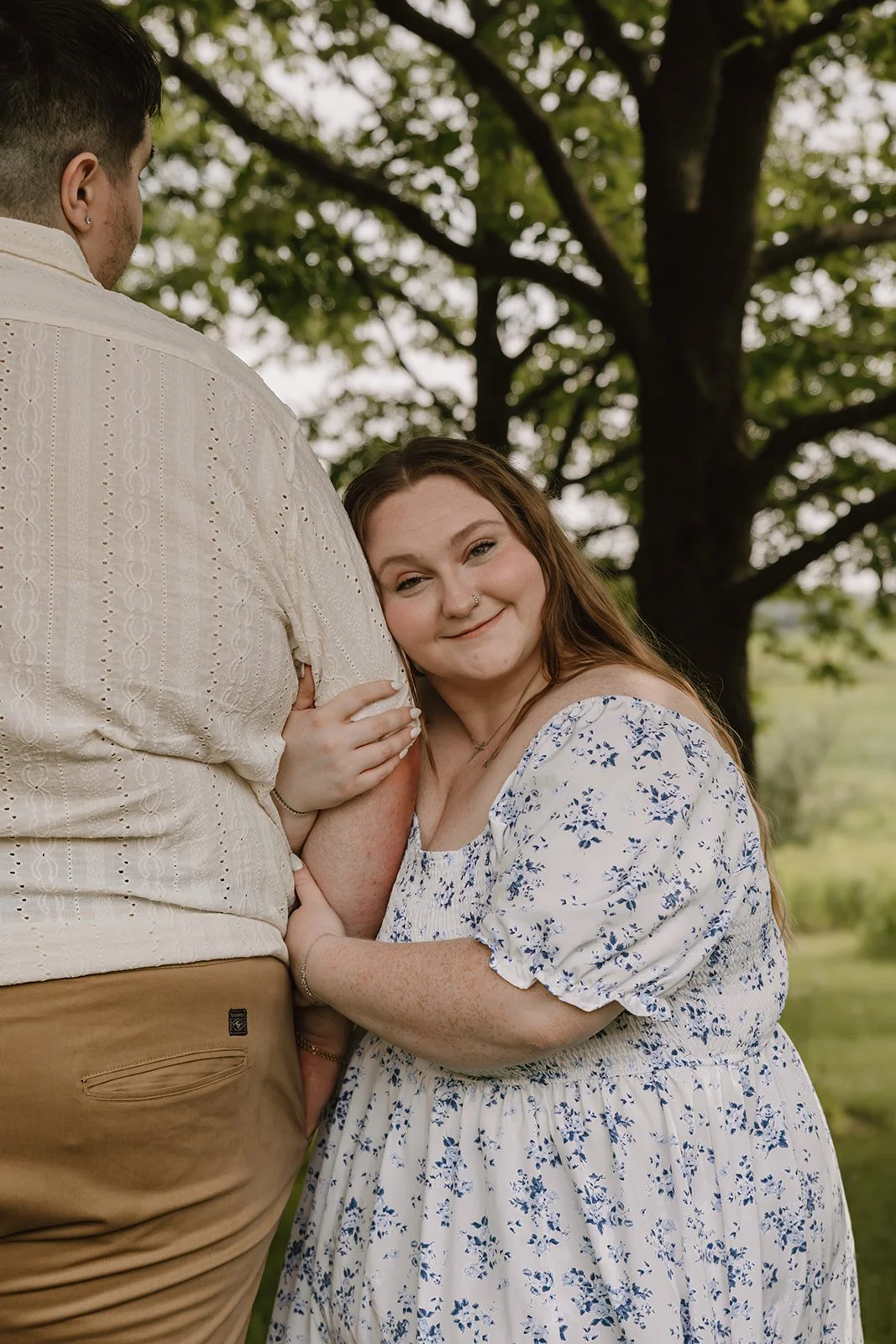
the way she leans into him works because she is not balancing herself in a random pose.
the close photographs work because they are focused on expressions and touch instead of trying to fit an entire performance into one frame.
you do not need to become a different couple for your engagement session.
you need guidance that helps the two of you remain recognizable.
so yes, you can tell me you are awkward.
you can warn me that one of you hates photos.
you can arrive with absolutely no idea what to do with your hands.
none of that scares me.
by the time we are finished, you will probably have spent more time laughing about how worried you were than actually feeling awkward.
and your gallery will look like the two of you—not two people attempting to recreate someone else’s pinterest board.
Let’s Work Together